Brain waves + eeg recording notes
Some definitions first:
spike / action potential
- one electrochemical signal which travels from neuron to neuron
- produced in response to stimuli or spontaneously
- lasts 1 ms
spike train
- “In a nutshell, spike trains are the language in which the external world is encoded into our brains.”
- a combinatorial sequence of spikes and silences
- if 1 is spike and 0 is silence, a spike train could look like 0010100011110101, with the first 0s as the latency between the stimulus and first spike
- exist at level of single neuron
local field potentials
- synaptic input means the signal one neuron sends another across a synapse
- synaptic input does not result in an action potential if not strong enough
- despite this, aggregating synaptic input of many packed neurons into different geometrics causes measurable extracellular voltage changes. this is the local field potential
- is a signal of coordinated activity of populations of neurons, not simply the sum of spikes
- much lower frequency compared to spikes, can obtain using low-pass filter on electrode data
electrical potential
- charges create electrical fields, such that if another charge is placed nearby is experiences a force
- electric potential is a way to describe difference in force between two points in the field
- voltmeters use two electrical contacts; they use the electric potential difference to move a little bit of charge, and from that figure out the potential difference (voltage)
- formally, it is $V = U/q$
- V = electrical potential in Voltz
- U = electrical potential energy in Joules
- q = charge in Coulombs
transistor basics
- take a silicon crystal. Si has 4 valence electrons. If you take half an Si crystal and throw in phosphorus with 5 valence electrons, you will have a surplus of electrons on that side. If you take the other half and throw in boron with 3 valence electrons, you will have “holes” of electrons
- electrons will diffuse from phosphorus side (N-type) to boron side (P-type). At the junction there will be no charge, but phosphorus side will have a positive charge (because it lost e-), and boron side will have a negative charge (because it gained e-)
- this difference in charge will create an electric-field force that will balance out the “force” of diffusion
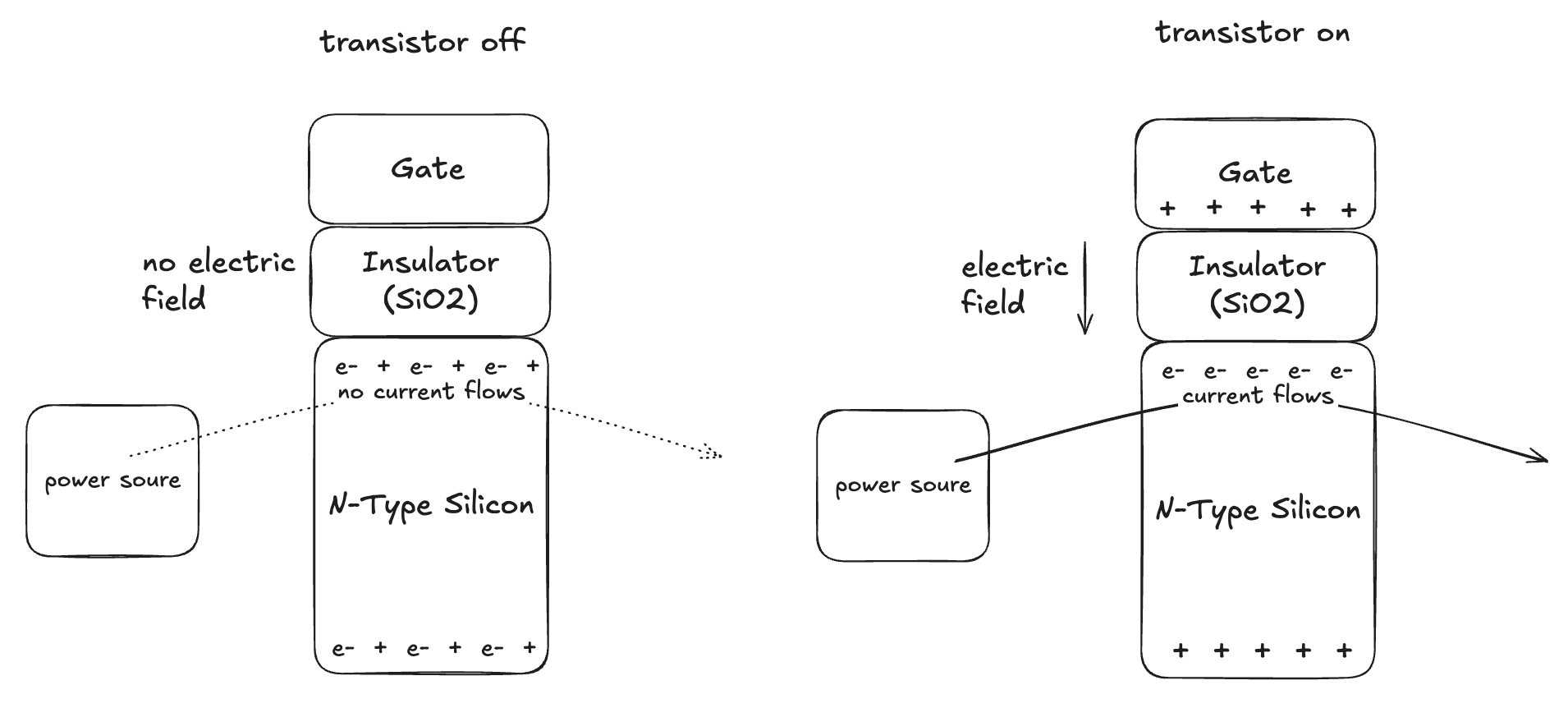
- there is a gate that can create a channel of charged particles that can carry a current. turning on the gate means the voltage of the power source can push a current through. how high the voltage of the gate is determines how big a channel of current is created and how much the power source pushes through. this is basically a transistor acting as an amplifier
voltmeter
- V = I * R
- there is a bandgap voltage reference which produces a constant voltage despite conditions (i.e. always 1V)
- transistors are used to amplify the voltage
- then that voltage is compared by a comparator to a series of standards to see how much the voltage is
- the “comparator” is also based on transistor technology
electrode
- one side is Na+, K+, Cl- ions in solution
- one side is “sea of electrons” in Ag metal
- Ag/AgCl interface connects the two, where the following chemical reaction takes place: AgCl + e− ⇌ Ag + Cl−
- this couples electron movement to ion movement in solution
- say an electrode is placed on the scalp, where there is an electric potential of 5 uV and the system is at equilibrium
- say the potential changes to 6 uV - this will push the chemical reaction in a direction and set equilibrium at a new electric potential
- the amplifier will measure the voltage difference between that and the reference electrode
eeg recording
- electrodes are placed all around the head; they are placed relative to anatomical reference points like the nose bridge or bump on skull
- each signal is the difference between electrodes, or an electrode and its reference
Brain waves are oscillations in electric potential at any level of organization, including single nuerons, spike trains, local field potentials, and even larger scale oscillations.