Vinyl creation
In my head, there are three types of entities that are involved in the creation of a vinyl. There is the signal (i.e. sound, AC current), there are devices that transform the signal within a medium (i.e. denoising) or between media (i.e. air to electrical), and there are media that store the waveform of the signal (i.e. numbers in RAM or grooves in a vinyl).
Signals:
- sound wave
- oscillation of air particles; frequency of oscillation corresponds to pitch
- analog electrical signal
- a smoothly changing voltage that represents sound; when connected to a circuit, current flows
- amplitude of the signal corresponds to loudness of the sound
- digital electrical signal
- the voltage can take on two values (bits), 0 or 1
- a sequence of these bits encode numbers which represent the amplitude of the sound
- the fidelity of the signal is determined by the sampling rate on the analog source and the bit depth, which is how many bits can represent a single sample (i.e. 0.9 vs 0.9999 vs 0.9999999)
Signal Transformers:
- microphone
- vibrating air molecules (sound) vibrate a sensitive membrane in the microphone. the membrane moves a coiled wire which wraps a magnet. faraday’s law generates a voltage
- since the membrane (and the coiled wire) moves back and forth, an alternating current (AC) voltage is produced
- ADC (analog-to-digital) converter
- the analog signal is read (sampled) at some sampling rate and stored into a binary number of some precision (bit depth)
- DAC (digital-to-analog) converter
- say my digital signal has 8 bits. each sample would look like 10010101 or 11011101 … etc.
- in the DAC, there is a series of 8 resistors with increasing resistance by a power of 2
- if the bit is 1, each bit is mapped to the resistor at the same index. if the bit is 0, it goes to ground. the total current through these resistors is summed in the circuit to give the voltage of the binary sample. this maps a sample to a voltage with jagged stepwise edges
- a low-pass filter smoothes the jagged edges into a smooth continuous analog signal
- mixing
- an audio signal, say from multiple instruments, is a sum of the signals of each instrument. mixing changes the weighting and characteristics of individual signals to make the final audio sound better
- an example is increasing loudness of vocals if they’re drowned out by percussion
- cutting lathe
- converts an analog audio signal to physical grooves in a vinyl
- the voltage changes drive movement of an electromagnet which moves a stylus in the shape of the waveform
Signal Storage:
- analog magnetic tape
- the analog eletrical current passes through a coil in the taping machine, which creates a changing magnetic field in the coil
- the changing magnetic field magnetizes particles on the tape into a continuous magnetic pattern
- digital file (ssd, hard drive, optical disk)
- bits imprinted onto some magnetic material like a hard drive, transistors like an ssd, or electrical circuits like RAM
- vinyl
- physical grooves
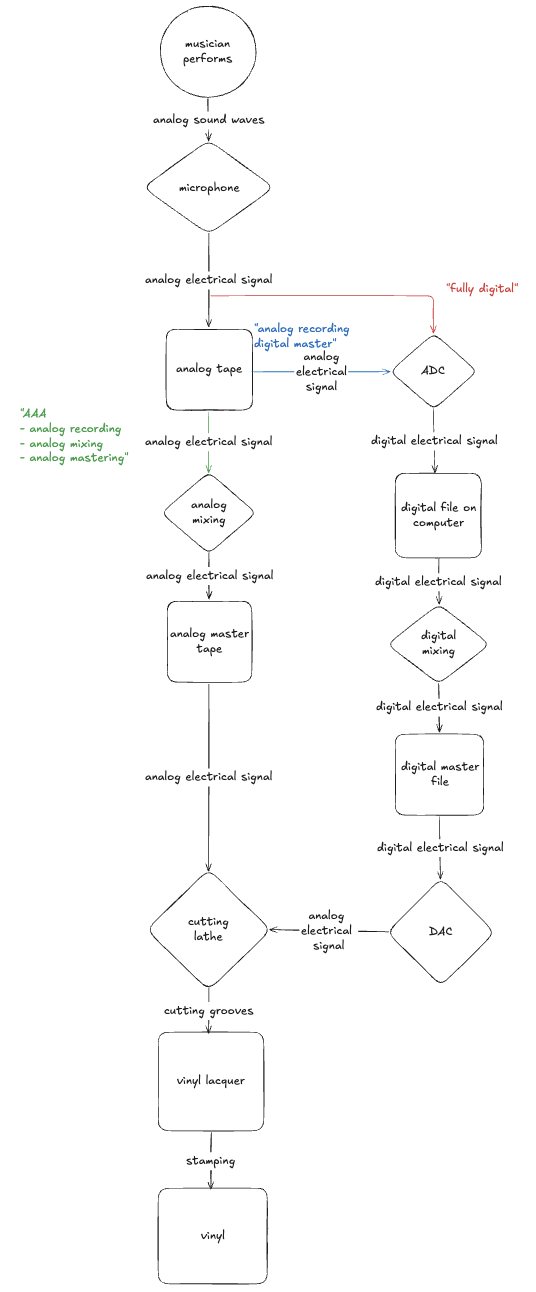
With definitions out of the way, this flowchart of how vinyls are made is more meaningful.
There are three important branches that are used to classify vinyl records:
- red arrow / “fully digital”: if the analog signal coming out of the microphone is immediately converted to a digital signal and stored only digitally, the vinyl is “fully digital”
- blue arrow / “analog recording digital master”: here, the first time the signal is stored, it is stored in analog. Since the mixing equipment is digital, the signal is converted to digital to mix
- green arrow / “AAA”: analog recording, analog mixing, analing mastering