Why did I choose to be a software engineer instead of a doctor?
Making a decision between options seems to require at least one of three things:
- low-enough stakes that a random option is preferred to prolonging the decision
OR
- evidence or experience from anyone (you or outside of you) that one option is preferred
OR
- reversability of the decision.
There are decisions, however, that don’t meet the above requirements. They are
- high stakes
AND
- unfavored by all evidence and anyone’s experiences
AND
- irreversible.
Choosing to spend a half to a third of my time for the next 20 to 40 years either writing software or practicing medicine felt high stakes. It also seemed irreversible. Leaving medical school certainly was. I had no good will from my program to let me take a third gap year, especially after only 1 year. Staying in medical school was also costly, if not by time or monetarily, then by effort. Within 6 months of a decision I’d have to take the 8-hour Step 1 exam, and within a year I would be deep into clinical rotations. Anyone who has completed medical school or residency can vouch - pushing through these hurdles requires a committment to the path. I couldn’t really flirt with another dedicated career on the side.
The experiences of others turned out to be so diverse and individual, that they were useless. I met with doctors, software engineers, doctors-turned-engineers, engineers-turned-doctors, tech executives, family, friends, and old med school classmates hoping to be swayed. In reality, I got exposed to countless discrete mindsets that shaped and influenced these people that did not apply to me at all. I remember talking to an M.D. Ph.D at the University of Chicago who told me he was working on his J.D., and that there was no harm in collecting degrees. Another time on a plane, a doctor from Pakistan told me I was foolish for considering leaving medicine, the highest calling. Every single medical student I met, almost without fail, joked to me “you’re smart” when they learned I was considering dropping out. A friend in medicine told me they would leave medicine if they just had a skillset in another high paying profession. Tech veterans dissuaded me from their industry, saying that between layoffs and AI-based volatility, I should choose a path with job security. Junior engineers in tech told me about their 6th vacation of the year while raking in more than most family medicine doctors. A community doctor told me that their work was tiring, and I should make this decision based on whether I was a people-person or not - that patients were customers, and the job was seeing 30 customers a day.
Some folks have asked me why I didn’t wrap up medical school and work as an M.D. in healthcare technology. I liked the act of writing software more than I liked what I had in my head the experience of seeing pateints. I didn’t think a doctor had any time to reasonably become a very good software engineer, and actually contribute to their software writing with their medical skills. Having worked at two healthcare startups, I’ve seen this up close. The medical or business knowledge of healthcare is entirely decoupled from the actual writing of software, with product managers sitting at the boundary. Probably not 100% true, but I thought it at the time.
The vampire problem is a thought experiment created by L. A. Paul, a philosophy professor, that questions how a person can rationally choose to become a vampire when they cannot know what it is like until they experience it. The actual process of becoming a vampire, and the lived experience of being a vampire changes a person. And because that person differs from the person before the decision, the best decision a priori may be different from posteriori.
So although I could try my best to take my current temperament and preferences into account, I also had to predict how I would transform by projecting my own mind through time, into the future, and hazarding a guess about what future me would like more.
So how did I ultimately make the decision?
Post-decision, my brain, in a physical sense, can be in state a having chosen option a, or state b having chosen option b. Pre-decision, my brain is in some ambigious state of ab.
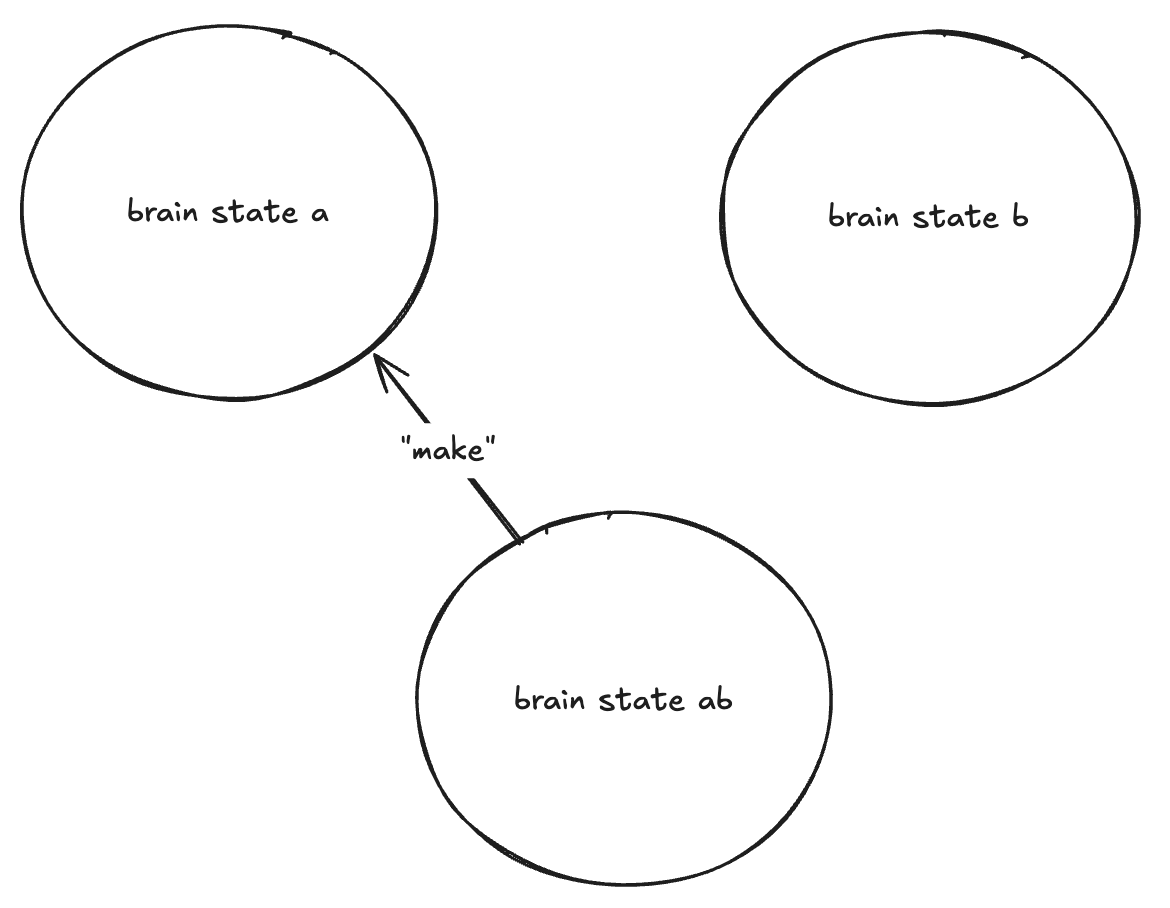
The cause of this transition is “make”.
I’m a physicalist, so I think the cause is 1) a set of classical processes like chemical bonds and neurons firing that were set in motion long before the decision moment and 2) quantum processes like decoherence that no one can really explain too too well. I am also not any variety of pansychist who believe consciousness is a fundamental feature of all reality and physical matter.
Does this mean that I belive we don’t have free will and that all decisions are in fact a combination of predetermined causality and randomness? Yes it does.
To preempt an objection I’ve heard before, some folks will say that the randomness added by quantum mechanics gives people free will. That’s flawed because randomness is not agency. Randomness doesn’t magically lead to goal-directed action.
And so I sometimes get the question, “Yash - why did you choose to be a software engineer instead of a doctor?” My honest answer is “I don’t know”.