Length contraction
Table of Contents
It’s a shame that special relativity is not covered at all in high school physics. If it were covered, even in a semi or non-mathematical capacity, I think the world would have more physicists.
The Problem
Sound waves are a pattern of moving air particles in a body of air. Surf waves are moving water particles in a body of water. In 1801, the double slit experiment showed that light can behave as a wave. So what is the “body” that light moves through?
The Hypothesis
How do you test if light is moving through something?
How do I know that I am moving through something? Say you strapped me to a skateboard and sent me at a constant speed, how could I tell if I was moving? The air on my face (drag) would be the only giveaway.
Two researchers named Michelson and Morley thought a reasonable possibility is that light travels in some substance, the “aether”, and attempted to detect the “aether wind” as the earth travels through space.
The hypothesis was simple: the aether would affect light differently if light were traveling parallel vs perpendicular to the direction of motion of the earth through space. Why? Because the earth also travels through this aether, and in the same way a bug traveling parallel-to-motion on my skateboard would experience more drag than the bug traveling perpendicular-to-motion, light should experience more drag if moving in the same direction as the earth than perpendicular to it.
The Experiment
The experiment sends light from a source to a partially silvered plate, which splits the beam into two, one continuing on its trajectory, and one going perpendicular. Mirrors equidistant to the silvered plates reflect the light back to the silvered plate and finally to a detector which measures the interference pattern to determine differences in how far the light beams have traveled. In the diagram, the blue beam travels parallel to earth’s motion, and the red beam perpendicular.
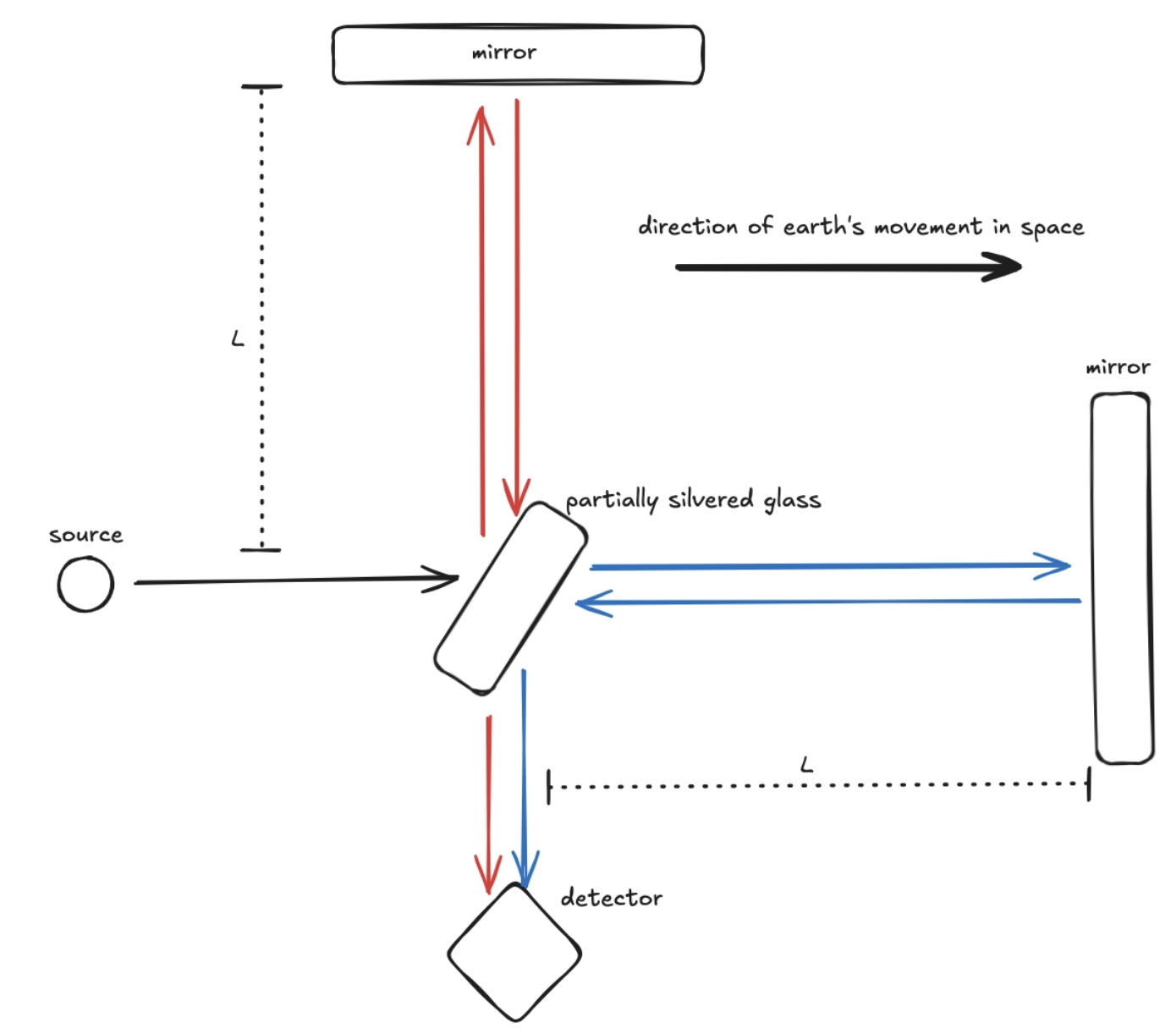
The Blue Beam (parallel to Earth’s motion)
A basic equation of fixed velocity motion is $\text{distance} = \text{velocity} \times \text{time}$. Since distance from the source to the silvered plate, and from the silvered plate to the detector is the same for both beams, we can ignore these lengths.
Partially Silvered Plate to Mirror: light travels L plus however much earth has moved at speed $u$.
- $\text{distance} = \text{velocity} \times \text{time}$
- $L + ut_1 = c * t_1$
Mirror back to Partially Silvered Plate: the reverse here, L minus however much earth moved at speed $u$.
$L - ut_2 = ct_2$
A little rearrangement:
$t_1 + t_2 = \frac{L}{c-u} + \frac{L}{c+u} = \frac{L(c+u)}{(c-u)(c+u)} + \frac{L(c-u)}{(c-u)(c+u)} = \frac{2Lc}{c^2 - u^2} = \frac{2L/c}{1-u^2/c^2}$
The total time the blue beam takes is $\frac{2L/c}{1-u^2/c^2}$
The Red Beam (perpendicular to Earth’s motion)
Partially Silvered Plate to Mirror: despite being perpendicular the motion of earth still affects how far light has to travel. Now light has to travel the hypotenuse of a right triangle where one side is L and the other is however much earth has moved at speed $u$.
$L^2 + (ut_3)^2 = (ct_3)^2$
Some rearrangement for red beam
$$ L^2 = (ct_3)^2 - (ut_3)^2 = c^2t_3^2 - u^2t_3^2 $$
$$ t_3^2 = \frac{L^2}{c^2 - u^2} $$
$$ t_3 = \frac{L/c}{\sqrt{1-u^2/c^2}} $$
Mirror back to Partially Silvered Plate: Same equation since the return journey is symmetric.
So the total trip time is $2t_3 = \frac{2L/c}{\sqrt{1-u^2/c^2}}$.
Comparing the beams
Comparing the beams we find that the following equivalence should hold true between the blue and red beams
$$ t_b = \frac{t_r}{\sqrt{1 - u^2/c^2}} $$
in particular, that the perpendicular red beam should take slightly less time than the parallel blue beam.
Reality
In reality, no time difference was observed.
Length Contraction
In order to justify the lack of discrepancy, one of the variables $L$, $c$, or $u$ must take a different value in parallel motion from perpendicular motion.
$u$: It doesn’t quite make sense that earth’s motion is different. The experiment for parallel and perpendicular were performed at the same time therefore earth could only have been one speed between the two directions.
$c$: One options is that light goes faster in the red beam than the blue beam. The perpendicular and parallal beams came from a single origin light beam before being split. For this to be true, the beams would somehow have to know their position in space.
$L$: Lorentz proposed and Einstein ultimately concluded that light’s speed stays constant, and instead the parallel-to-motion distance contracts.
$$ L_b = L_r * \sqrt{1-u^2/c^2} $$
Spacetime
The choice does seem jarring, but I suppose that is Einstein’s genius: to propose that the speed of light is constant, and to deduce from it that space and time are coupled. At faster speeds, distances contract. That is pretty insane.